
Evening Desert Safari Dubai: The Complete Guide to Planning Your Perfect Desert Night
Dubai has no shortage of things to do. The city is practically engineered for experience — the architecture alone is enough to keep you busy for days, and the food, the shopping, the beaches, and the nightlife fill in the rest. But ask anyone who has spent serious time here — people who have come back two, three, five times — and they will tell you the same thing: the evening desert safari is the one that sticks.
Not because it’s the most thrilling thing you’ll do in Dubai. Not because it’s the most luxurious. But because it’s the most complete. In the space of five to six hours, you get adventure, culture, food, entertainment, silence, and something that comes close to genuine wonder. It’s the experience that reminds you why travel is worth doing in the first place.
This guide covers everything. What an evening desert safari in Dubai actually involves, what time it starts and ends, what you should wear and bring, how to choose the right package, what the different activities feel like, what the food is like, and what to do when you get back. If you’re planning an evening desert safari — whether it’s your first time in Dubai or your fifth — this is the only guide you need to read.
What Is an Evening Desert Safari in Dubai?
An evening desert safari is a guided excursion into the Arabian desert, timed specifically around the late afternoon and evening hours. It typically begins with hotel pickup between 3:00 and 3:30 PM and ends with a drop-off around 9:30 to 10:00 PM. The timing is deliberate: you arrive in the desert while the light is still golden and dramatic, you stay through the sunset, and you spend the rest of the evening at a Bedouin-style desert camp under the open sky.
What separates the evening safari from daytime desert experiences is the combination of activities and atmosphere it delivers. The daytime desert is harsh and unforgiving. The evening desert is generous. The temperature drops to something genuinely comfortable, the light turns extraordinary, and the camp comes alive with food, music, and entertainment that you simply don’t get in a midday excursion.
For most visitors, the evening desert safari is the Dubai experience they remember most.
What Time Does Evening Desert Safari Start and How Long Does It Last?
Most evening desert safari packages in Dubai operate on a consistent schedule:
- Hotel pickup: 3:00 PM – 3:30 PM
- Arrival at the desert: approximately 4:00 PM
- Dune bashing and activities: 4:00 PM – 5:30 PM
- Sunset at camp: 5:30 PM – 6:30 PM (seasonal variation)
- Dinner and entertainment: 6:30 PM – 9:00 PM
- Return drop-off at hotel: 9:30 PM – 10:00 PM
From door to door, you’re looking at roughly six to seven hours. That’s long enough to feel like you’ve genuinely gone somewhere — not a rushed two-hour side trip, but a proper evening that unfolds at its own pace. Most people are surprised by how full it feels.
The timing shifts slightly across seasons. In summer months, sunset comes later. In winter (December through February), it arrives earlier and the post-sunset air gets meaningfully cooler. Both versions have their appeal, though winter evenings are generally more comfortable for the outdoor camp portion.
Where Does the Evening Desert Safari Take Place?
The vast majority of evening desert safaris in Dubai operate in one of two main desert areas:
Lahbab Desert (Dubai Desert Conservation Reserve) — Located approximately 45 to 60 minutes from central Dubai, Lahbab is home to the iconic red sand dunes that have become synonymous with Dubai desert photography. The dunes here are dramatic, deeply colored, and genuinely impressive. Most premium safari operators use this area because the terrain and scenery are exceptional.
Al Khali (The Empty Quarter Region) — Further from the city, accessed primarily for longer or overnight experiences rather than standard evening safaris.
For a standard evening desert safari, you’re almost certainly heading toward the Lahbab red dunes and the Dubai Desert Conservation Reserve. The drive itself is part of the experience — watching the city fade and the desert open up around you is a transition that feels significant.
What Happens During an Evening Desert Safari: Activity by Activity
Dune Bashing
The evening almost always begins with dune bashing, and it’s an effective opener. Your driver deflates the tires of the 4×4 slightly — this increases surface contact and improves control on sand — and then takes the vehicle through a sequence of dunes that involves cresting, dropping, sliding sideways, and occasionally going up slopes that look completely vertical from inside the car.
It lasts around 30 to 45 minutes, it’s genuinely exciting, and it turns any group of strangers into a group of people who have shared something together. The quality of the experience depends heavily on the driver’s skill, and reputable operators invest in experienced desert drivers who know how to calibrate the intensity for the group they’re carrying.
If you’re prone to motion sickness, sitting in the middle seat helps, and it’s always worth mentioning it to your driver before you start.
Sunset Stop and Photography
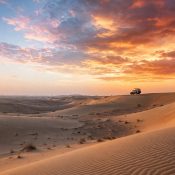
At some point during the dune bashing — usually timed precisely — your driver will stop on a high dune for a sunset photography break. This is when you get out, climb to the top of the dune if you want, and watch the sun drop toward the horizon.
It’s difficult to oversell this. The red dunes of Lahbab at sunset turn colors that don’t have clean names — deep rust, burnt sienna, a kind of glowing amber that the photos get close to but don’t fully capture. The sky goes orange, then pink, then violet. The whole sequence takes about 20 minutes and it’s completely silent except for the wind.
Bring your camera. Charge your phone the night before. You’ll use it.
Arrival at the Desert Camp
After the dune bashing and sunset, you’re driven to the Bedouin-style camp for the rest of the evening. This is where the pace slows and the cultural experience begins.
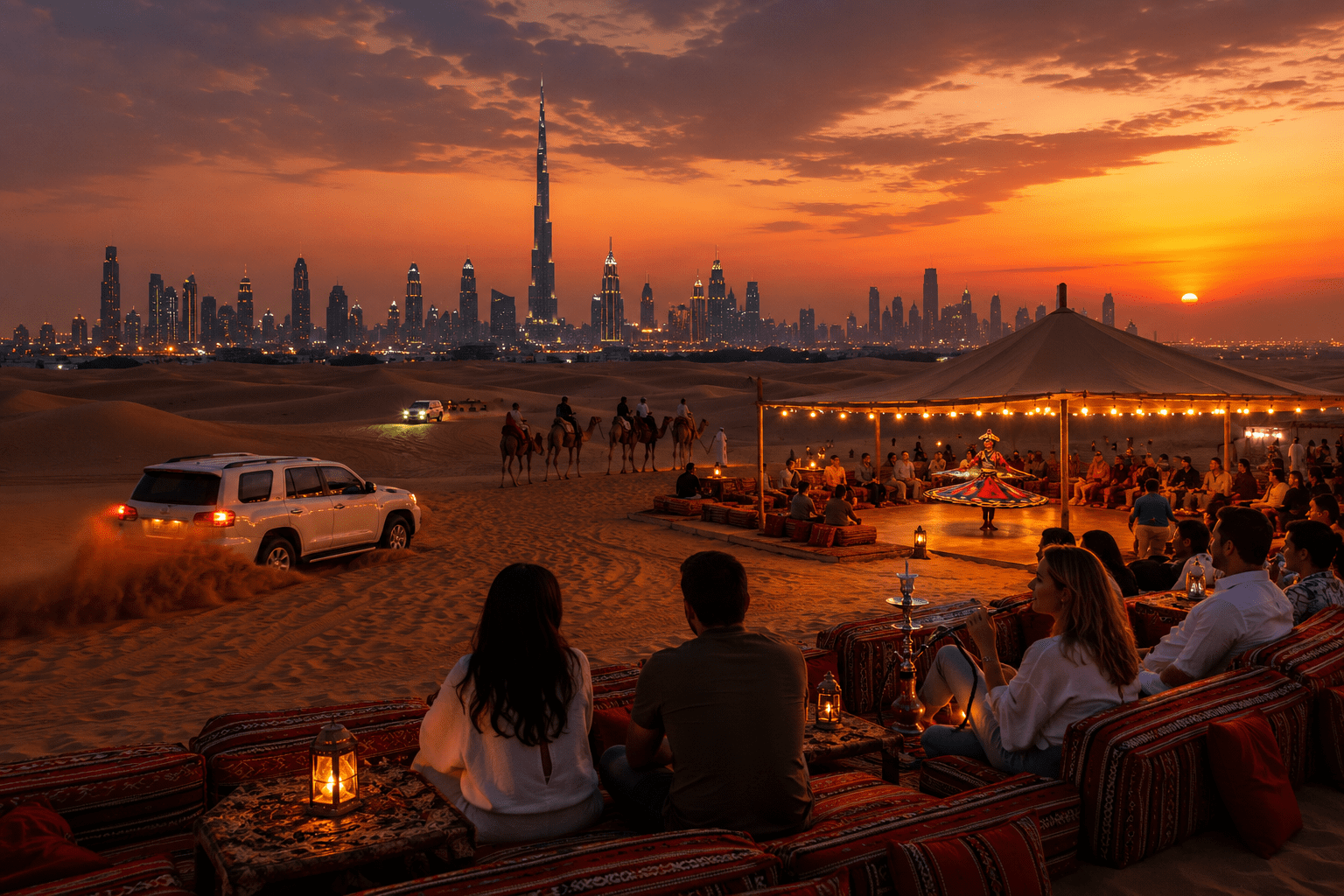
A well-run desert camp is genuinely beautiful. Low tents with Arabic rugs and cushioned seating, lanterns and fire torches creating warm pools of light, the smell of grilling meat and Arabic coffee mixing with the cool desert air. It feels like a place, not a set — and the best operators take that seriously.
Arabic Coffee and Dates
Your arrival at camp is marked by the traditional Arabic welcome: qahwa (Arabic coffee) and dates. The coffee is light-bodied, slightly bitter, flavored with cardamom and sometimes saffron, and served in small handle-less cups called finjan. It’s refilled until you give a specific wrist-tilt gesture to signal you’ve had enough.
This is not just a nice touch. It’s the traditional Emirati expression of hospitality — the same gesture of welcome that has opened every desert meeting for centuries. It sets the tone for the entire camp experience.
Camel Riding
Most camps have camels available for a short ride — typically 10 to 15 minutes around the camp perimeter. The experience is brief, but it’s memorable. Camels are enormous animals up close, with their own very particular personality (somewhere between dignified and completely indifferent to your presence). The moment they stand up — with a lurching, front-legs-first motion that nobody ever quite prepares for — is a universal crowd highlight.
Once you’re moving, the rhythm is slow and swaying, and the height gives you a completely different perspective on the camp and the dunes around it.
Sandboarding
If included in your package, sandboarding happens on a nearby dune. You’re given a board — similar to a small snowboard — and you either stand or lie flat and go down. The standing version requires more balance than it looks like. The lying-flat version is faster and considerably easier to commit to.
The climb back up the dune after each run is genuinely tiring in a way that surprises people. Desert sand shifts under your feet and the ascent works muscles you don’t usually notice. It’s also the best part of the view.
Henna Painting
Inside the camp, a henna artist applies traditional Arabic designs to your hands. The process takes 10 to 20 minutes depending on the complexity of the design, and the results last one to two weeks depending on your skin type and how long you leave the paste to dry.
People who approach this skeptically — “not really my thing” — often end up being the ones who sit longest. The patterns are genuinely beautiful and the application process is weirdly relaxing.
Traditional Arabic Attire
Most camps have a selection of traditional garments available for photographs — kanduras for men, abayas for women. It takes about two minutes and produces photographs that people actually print and frame, which is not something most travel photos can claim.
Falconry
A resident falconer will often bring one of the birds through the camp and allow guests to hold it on a gloved arm. Falcons in the UAE are not merely a tourist prop — they are deeply embedded in Emirati heritage and culture, connected to the historical way of life in this desert for generations. Watching the bird up close, understanding even a small part of its significance, adds something real to the camp experience.
Belly Dancing
The evening entertainment typically begins with a belly dancer performing to traditional and contemporary Arabic music. It’s a professional performance, not a reluctant gesture, and it consistently gets a strong reaction from guests regardless of how they felt about it going in.
Tanoura Dance
The Tanoura is the Sufi whirling performance — a dancer in a layered, brightly colored skirt who spins continuously for 15 to 20 minutes without stopping. The skirt fans outward into a full circle as the speed increases, and the dancer often holds additional spinning elements above their head while maintaining the rotation. It’s hypnotic in the literal sense of the word — you stop thinking about other things and just watch.
Fire Show
Many desert camp evenings close with a fire performance — a skilled performer working with fire poi, fire staffs, or similar equipment against the dark desert sky. The stars above, the fire below, the cool air around you: it’s a genuinely dramatic ending to a full evening.
BBQ Dinner
The BBQ dinner at a Dubai desert camp is a proper spread. The format is typically buffet, with a rotating selection that usually includes grilled lamb, chicken kebabs, beef kofta, rice dishes, hummus and pita, fresh salads, a mezze section, grilled vegetables, and desserts including kunafa, fresh fruit, and sometimes Umm Ali (a warm Arabic bread pudding).
Vegetarian options are consistently available at reputable camps. If you have specific dietary requirements — vegan, gluten-free, allergies — it’s worth confirming at the time of booking.
The quality of the food varies between operators, and it’s one of the clearest markers of a good safari company versus a budget one. A good camp dinner is genuinely excellent. Eating outside, under the open sky, with the camp atmosphere around you and a full evening’s worth of activity behind you, makes everything taste better anyway.
Evening Desert Safari Packages: What’s Available
Not all evening desert safaris are built the same way. Here’s a breakdown of the main types:
Standard Evening Desert Safari
The baseline experience: hotel pickup and drop-off, dune bashing, camel riding, camp visit with entertainment, BBQ dinner. This is the right choice for first-timers who want to understand what the experience is before adding layers to it.
Sunspire Tourism’s Evening Desert Safari covers the full experience — dune bashing, sunset stop, camel riding, henna, traditional attire, belly dancing, Tanoura performance, fire show, BBQ dinner, and the Arabic coffee welcome. It’s comprehensive without feeling overpacked, and the pacing gives the evening room to breathe.
Evening Desert Safari with Quad Biking
For people who want the full camp experience plus active off-road time under their own control, the quad bike addition changes the character of the evening meaningfully. Instead of just experiencing the desert as a passenger, you drive it yourself — and 30 minutes of quad time on red sand dunes is long enough to actually develop a feel for the terrain rather than just scratch the surface.
The Evening Desert Safari with 30-Minute Quad Bike from Sunspire Tourism pairs the complete camp experience with a proper quad biking session. It’s well-sequenced — the quad time happens while there’s still light, and the camp experience follows. Good for people who want both adventure and atmosphere in the same evening.
Dune Buggy Experience
If the off-road vehicle experience is the primary draw, the dune buggy takes it further. Rather than a quad, you’re in a purpose-built off-road buggy — lower, faster, and more dynamic. It’s a more intense mechanical experience and appeals to people for whom the driving itself is the point.
The Dune Buggy Dubai Tour is built around the vehicle experience rather than the camp. If you’re weighing this against the standard safari, the question is really what you want the center of gravity of the evening to be — the culture and atmosphere, or the driving.
Private Evening Desert Safari
Private safaris offer the full experience with a dedicated vehicle and guide, no shared group dynamic, and more flexibility on timing and activity sequencing. They cost more and are worth it for couples, families with young children, or groups who simply don’t want the energy of a shared-group experience.
Overnight Desert Safari
For those who want to extend the experience beyond an evening, overnight camping in the desert is a genuinely different proposition. You stay after the group leaves, sleep in a furnished camp tent, and wake up to a desert sunrise that is among the most peaceful experiences Dubai offers. It’s the slow version of everything the evening safari delivers fast.
How to Choose the Right Evening Desert Safari Package
There are hundreds of operators offering evening desert safaris in Dubai. The quality gap between the best and the worst is significant. Here’s what to look at when making your decision:
Dune location. Lahbab red dunes are meaningfully more impressive than the flatter, lighter-colored dunes closer to the city. Ask specifically where the safari goes.
Group size. Smaller groups mean more attention from drivers and guides, more flexibility, and a generally better experience. Know how many people will be in your vehicle.
Inclusions. Compare package to package on what’s actually included — some operators list “quad biking” as an inclusion and mean five minutes of supervised riding. Specific time allocations matter.
Driver experience. Dune bashing is safe when done by skilled drivers on familiar terrain. Ask how long the company’s drivers have been operating the routes.
Camp quality. Photographs of the actual camp tell you a lot. Look for proper furnished seating, quality tent structures, and a setup that feels like a place rather than a temporary folding-chair arrangement.
Cancellation policy. Desert activities are weather-dependent (though Dubai’s weather is excellent most of the year). Check the cancellation and rescheduling terms before you commit.
What to Wear for an Evening Desert Safari
This is one of the most commonly asked questions and the answers online are sometimes confusing. Here’s the practical version:
Clothing: Light, breathable fabrics that cover your shoulders and knees. This is appropriate both culturally and practically — sand gets into everything, and coverage reduces discomfort without adding heat. Linen or cotton works well.
Footwear: Closed shoes or trainers, not sandals. The sand in the dunes is fine and hot (even in the evening it retains warmth from the day), and sandals fill with it instantly. If you wear sandals, you’ll spend the first 20 minutes being annoyed about it.
Layers: In the winter months (October through March), bring a light jacket or sweater for the post-sunset hours. Temperatures after dark in the desert can drop to 15°C in January and February, which feels cold when you’ve been outdoors for several hours.
Accessories: Sunglasses are useful for the afternoon arrival portion. A scarf or buff doubles as sun protection and sand protection during dune bashing (windows-up vehicles make this a non-issue, but it’s useful if you step out).
Valuables: Leave expensive jewelry and anything you’d be upset to lose at the hotel. Sand gets everywhere.
Is an Evening Desert Safari Safe?
Yes. The evening desert safari is a well-established, extensively operated experience with a strong safety record across reputable operators.
A few specifics worth knowing:
Dune bashing is the activity that raises the most questions, and reasonably so — it involves a large vehicle on steep sand slopes at angles that look alarming. The drivers are experienced professionals who know the terrain intimately. The risk is low when managed by a reputable operator; the key is not booking with the cheapest option available, where cost savings often come from cutting corners on driver experience and vehicle maintenance.
Motion sickness is the most common issue during dune bashing. If you’re prone to it, sit in the middle seat, keep your eyes on the horizon when possible, and tell your driver — they can adjust intensity.
Dehydration is a real consideration, especially in summer. Reputable camps provide water throughout the evening. Bring a bottle with you.
Sun exposure during the afternoon portion is worth taking seriously, particularly with children. Sunscreen and head covering during the pre-sunset activities is recommended.
Is Dubai Desert Safe at Night?
The desert areas used for evening safaris are not remote wilderness — they are established, well-managed routes that operators know thoroughly. You are never out of contact with the camp or other vehicles. The camps themselves are well-lit, staffed, and organized.
The only meaningful safety consideration at night is the return journey — make sure you’re with a reputable operator whose drivers are equally experienced on the road back to the city in darkness.
Best Time of Year for an Evening Desert Safari in Dubai
The short answer is October through April. This covers the cooler months when the daytime desert is manageable, the evenings are genuinely pleasant, and the post-sunset camp experience is comfortable without requiring heavy layers.
Peak season (November through February) offers the best evening temperatures — cool enough to enjoy the outdoor camp comfortably, clear skies almost every night, and spectacular winter sunsets.
Shoulder season (October, March, April) is warm but very manageable for an evening safari. The sunset colors in October can be particularly dramatic.
Summer (May through September) — Dubai’s summer is extreme, with daytime temperatures regularly exceeding 45°C. Evening desert safaris still run, and the sunset and nighttime camp experience is perfectly enjoyable once the sun is down, but the late afternoon activities are hot. If summer is when you’re visiting, go — just set expectations appropriately for the first hour.
Frequently Asked Questions About Evening Desert Safari Dubai
Can children do an evening desert safari? Yes, and they often enjoy it more than the adults. Dune bashing, camel riding, and sandboarding are all accessible for children of most ages. The entertainment portion of the camp evening is universally engaging for kids. The main consideration is the late timing — if your children go to sleep early, a 10:00 PM return may be difficult.
Is the food at the desert camp good? At a reputable operator, yes — genuinely good. The BBQ spread is fresh, generous, and includes a range of options. The open-air setting and the appetite built up by an active evening make it better than the context might suggest.
What if it rains? Rain in Dubai is extremely rare — the city averages fewer than 25 days of precipitation per year, and the desert sees less than that. The practical risk of a rain-affected safari is very low. Most operators have tent structures that handle light rain without affecting the experience.
Do I need to tip? Tipping is not obligatory but is appreciated, particularly for excellent drivers. A tip of AED 20–50 per vehicle for the driver is a reasonable gesture if the experience was good.
Can I do an evening desert safari if I don’t drink alcohol? Absolutely. The desert camp environment is naturally non-alcoholic for the most part, and some camps are entirely dry. The cultural and entertainment experience is complete and fulfilling without it.
Why the Evening Desert Safari Is Worth Your Time
There’s a version of the evening desert safari that people book reluctantly — because their group wanted to, because it seemed like the thing to do in Dubai, because it was on a list somewhere. And then there’s the version they describe afterward.
Almost without exception, the description afterward is better than the expectation.
The desert is one of those places that changes the scale of things. Standing on a dune watching the sun go down over a landscape that extends to the edge of the visible world puts the city — with its very deliberate impressiveness — in a different kind of perspective. The camp brings you back to warmth and company and excellent food. The entertainment is genuinely entertaining. The stars, if you remember to look up, are extraordinary.
It’s an evening that moves between registers — adrenaline to stillness, vastness to intimacy, heat to cool air — in a way that very few experiences manage. And it does all of this in a single evening, without asking you to choose.
That’s why it’s the one that stays with people.
Plan Your Evening Desert Safari
Whether you’re after the full cultural camp immersion, the adrenaline of quad biking through the red dunes, or the raw freedom of a dune buggy out on open sand — the right evening desert experience is the one that matches what you actually want from it.
Browse Sunspire Tourism’s evening desert safari options to find the version that fits your group, your timeline, and your appetite for adventure:
- Evening Desert Safari – Full Experience — The complete evening: dune bashing, sunset, camel riding, cultural camp, entertainment, and BBQ dinner under the stars.
- Evening Desert Safari with 30-Minute Quad Bike — Everything above, plus 30 minutes of solo quad biking through the Lahbab red dunes.
- Dune Buggy Dubai Tour — For those who want the off-road vehicle experience at the center of the evening.
The desert is 45 minutes from the city. An evening out there is the most complete five hours you’ll spend in Dubai.
This is the pillar guide for Sunspire Tourism’s evening desert safari content. Related guides covering individual activities — dune bashing, quad biking, camel riding, sandboarding, overnight camping, and more — are linked below as they are published.
Experience the Magic of Arabian Desert Safari
Embark on an unforgettable journey through the golden dunes of the Arabian Desert. From thrilling dune bashing to mesmerizing sunset views and traditional Bedouin experiences, create memories that will last a lifetime.

Recent Posts

Evening Desert Safari Quad Bike: What to Expect