
Morocco Travel Guide: Imperial Cities, Food, and What to Actually Expect
Why Morocco Belongs on Your Travel List
Morocco sits where three worlds overlap Arab, Berber, and Andalusian and the result is unlike anywhere else in North Africa or Europe. One day you’re standing on a cliff overlooking the Atlantic; the next you’re lost (happily) in a 1,000-year-old medina where nobody drives cars because the streets were built before cars existed.
This Morocco travel guide covers the country’s most visited cities, what’s genuinely worth your time in each, and how food fits into the whole picture. Whether you’re planning a two-week organized tour or a loose family holiday, this is what you need to know.
The Imperial Cities
Marrakech
Marrakech is where most visitors start, and it earns the attention. Jemaa el-Fnaa — the central square — shifts character throughout the day. Mornings are quiet. By evening it’s all smoke from food stalls, drummers, and storytellers working the crowds. It’s chaotic in a way that’s hard to describe and easy to fall for.
Beyond the square: Majorelle Garden is genuinely beautiful (go early to beat the crowds), Bahia Palace rewards slow exploration, and the Saadian Tombs are small but extraordinary. The souks around the medina sell everything from handmade leather slippers to Argan oil — bargaining is expected.
Marrakech also has some of the best riads in the country for accommodation. A mid-range riad with a rooftop terrace will cost you far less than a comparable hotel in Europe.
Don’t miss: An evening at Chez Ali Marrakech a dinner experience that combines a Moroccan banquet with folkloric performances from different regions and a Fantasia show where riders charge across an open arena on horseback. It’s theatrical, noisy, and exactly the kind of thing you’ll talk about later.
Fes
If Marrakech is the spectacle, Fes is the depth. The old medina (Fes el-Bali) is a UNESCO World Heritage Site and one of the largest car-free urban areas in the world. It has around 9,000 streets — many of which dead-end or loop back on themselves. Getting lost is part of the visit.
The Chouara Tannery is the most-photographed spot: leather workers standing in stone vats of natural dye, the whole complex visible from terraces above. It smells. It’s also genuinely fascinating.
Fes is home to the University of al-Qarawiyyin, founded in 859 AD — generally considered the oldest continuously operating university on earth. The city takes its history seriously, and that seriousness is part of its character.
Best for: Travelers who want authentic cultural immersion over convenience.
Meknès
Meknès doesn’t get the attention it deserves. It’s quieter than Fes (30 minutes away), the crowds are smaller, and the imperial monuments — especially the Bab Mansour gate — are just as impressive. The Royal Stables and Heri es-Souani granary are worth a half-day.
Many visitors see Meknès as a day trip from Fes, but it’s worth an overnight stay if your schedule allows.
Rabat
Morocco’s capital is often skipped, which is a mistake. Rabat is clean, unhurried, and genuinely pleasant to walk around. The Oudaya Kasbah — a blue-and-white neighborhood above the river — has some of the best ocean views in Morocco. Hassan Tower and the Mausoleum of Mohammed V are the main historic draws.
As a UNESCO World Heritage Site, Rabat has invested heavily in preservation. It’s a good choice for families or anyone who wants a break from the more tourist-heavy cities.
The Northern Cities
Chefchaouen
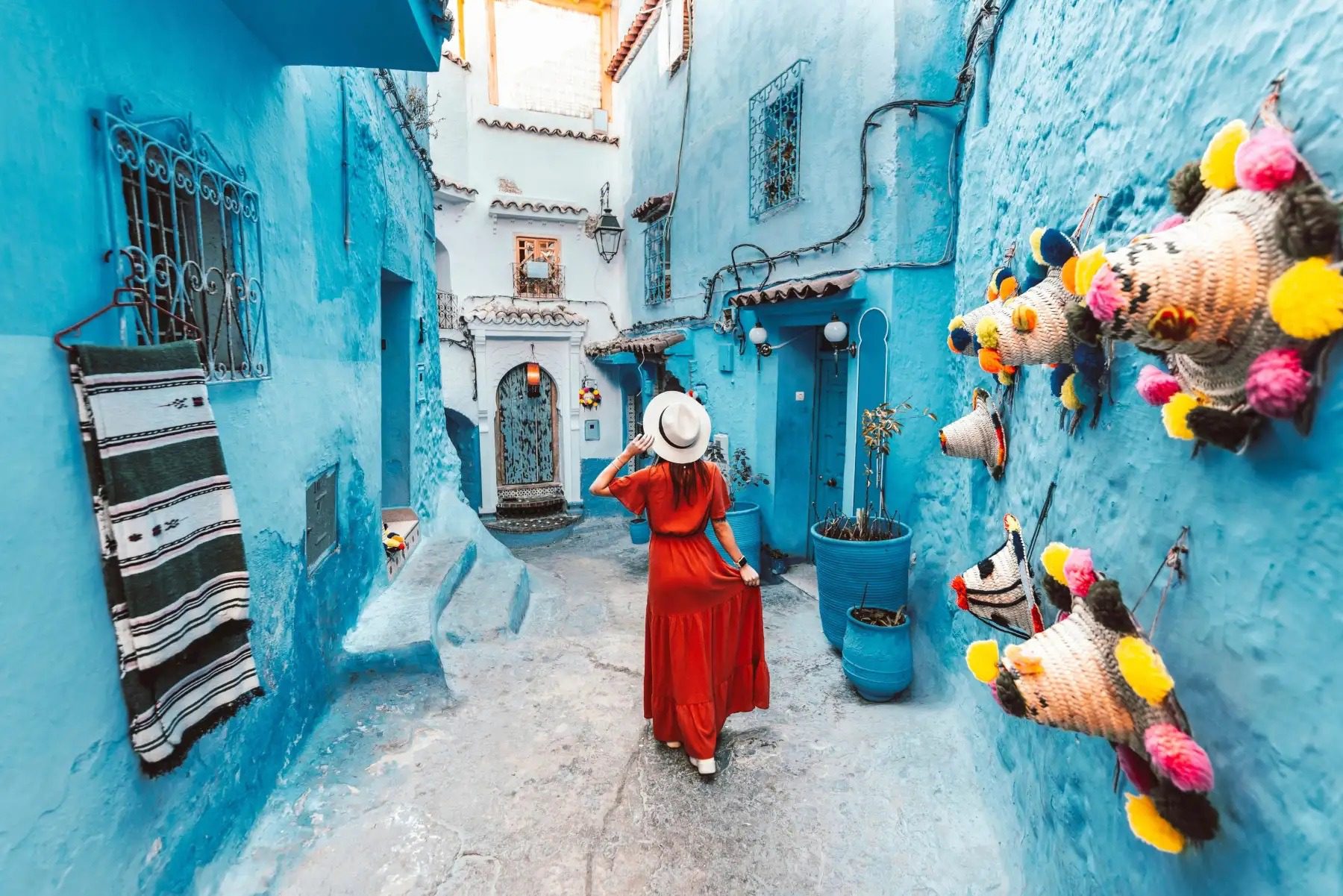
Yes, it really is that blue. The entire old medina is painted in shades of blue and white, and walking through it on a quiet morning (before the day-trippers arrive from Fes or Tangier) is one of the best experiences in Morocco.
Chefchaouen sits in the Rif Mountains at around 600m altitude, which keeps it cooler than the south. There are hiking trails nearby, including routes to the Cascades d’Akchour waterfall. The town itself is small enough to explore fully in a day, but most people stay two nights.
Practical note: Chefchaouen is best reached by bus from Fes or Tangier. The roads are winding but scenic.
Tangier
Tangier is the entry point for many visitors arriving from Spain via ferry. It has a complicated reputation — historically chaotic, now significantly cleaned up — and the renovated port area and waterfront have made it a legitimate destination rather than just a transit stop.
The Kasbah has good views across the Strait of Gibraltar toward Spain on a clear day. The city’s cosmopolitan history (it was an international zone for much of the 20th century, attracting writers like Paul Bowles and Jack Kerouac) gives it a distinct atmosphere you don’t find elsewhere in Morocco.
Casablanca
Casablanca is Morocco’s commercial capital and its largest city. Most travelers pass through rather than linger, but the Hassan II Mosque — built partially over the Atlantic Ocean — is one of the most impressive pieces of architecture in Africa. The guided interior tour is worth taking.
The Corniche (beachfront promenade) is good for a walk, and the Art Deco architecture in the downtown area is underrated. That said, Casablanca is primarily a business city, and the historic medina is small compared to Fes or Marrakech.
Moroccan Food: What to Eat and Where
Moroccan cuisine has real range. It’s not just tagine (though tagine is excellent). Here’s what to prioritize:
Tagine — slow-cooked meat or vegetables in a conical clay pot. Lamb with prunes and almonds is the classic version. Every restaurant does it; quality varies enormously.
Couscous — traditionally served on Fridays. Lamb, seven vegetables, and broth. A good couscous is a different experience entirely from the quick-cook packet version most people know.
Bastilla (Pastilla) — a savory-sweet pie, typically pigeon or chicken with almonds and cinnamon wrapped in thin warka pastry. Sounds unusual, tastes remarkable.
Harira — a thick soup of tomatoes, lentils, chickpeas, and lamb, usually eaten at sunset during Ramadan but available year-round.
Msemen and Beghrir — Moroccan flatbreads and honeycomb pancakes, best eaten fresh at a street stall with argan oil and honey.
Mint tea — served with ceremony, very sweet, poured from height to create foam. Refusing it is mildly rude; accepting a second glass is expected.
Food in Morocco is meant to be shared. The bigger the table, the better the meal.
Practical Travel Tips
- Best time to visit: March–May and September–November. July and August are extremely hot inland.
- Dress code: Conservative dress is appreciated outside of tourist resorts, especially in medinas and mosques.
- Haggling: Standard in souks and markets. Start at roughly half the asking price.
- Getting around: Trains connect Casablanca, Rabat, Fes, and Marrakech. Intercity buses (CTM is reliable) cover most other routes. Taxis are cheap but always agree on a price first.
- Language: Arabic and Amazigh (Berber) are official. French is widely spoken in cities. Spanish is useful in the north.
- Visa: Citizens of most Western countries can enter without a visa for up to 90 days.
Suggested Itineraries
7 days: Marrakech (3 nights) → Fes (2 nights) → Chefchaouen (2 nights)
10 days: Add Rabat (1 night) and Meknès (1 night) between Marrakech and Fes
14 days: Full circuit including Casablanca, Tangier, and a desert excursion from Fes toward Merzouga
If you’d rather not piece it together yourself, Traces Berbères offer guided tours and day excursions from Marrakech — including desert routes, High Atlas day trips, and the Ouzoud Falls — with local guides who know the terrain well.
Final Word
Morocco rewards the traveler who slows down. The country’s best moments aren’t always the famous ones — they’re the glass of tea pressed into your hands by a shopkeeper who expects nothing, the call to prayer echoing across rooftops at dusk, the moment you find a courtyard that the guidebook missed entirely.
Plan the framework, then leave room for detours. holiday, Morocco promises experiences that will stay with you forever.
Experience the Magic of Arabian Desert Safari
Embark on an unforgettable journey through the golden dunes of the Arabian Desert. From thrilling dune bashing to mesmerizing sunset views and traditional Bedouin experiences, create memories that will last a lifetime.

Recent Posts
Evening Desert Safari Quad Bike: What to Expect